News
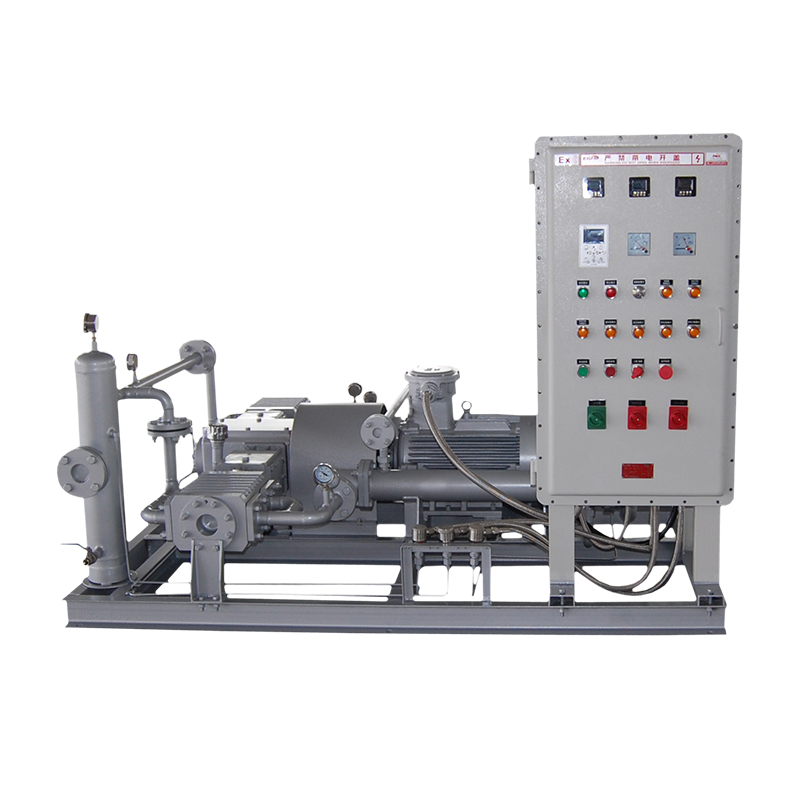
What is the working principle of reciprocating ethylene compressor?
The reciprocating ethylene compressor mainly converts the rotary motion of the driving machine into the reciprocating motion of the piston through the crank-connecting rod mechanism, and periodically completes the working cycle of gas suction, compression and discharge, thus increasing the pressure of ethylene gas.
1. Inhalation process When the piston moves from the top dead center to the bottom dead center of the cylinder, the working volume of the cylinder increases and the pressure decreases. When the pressure in the cylinder is lower than that in the intake pipe, the intake valve is opened under the pressure difference, and ethylene gas is sucked into the cylinder.
2. Compression process After the piston reaches the bottom dead center, it moves in the opposite direction, the working volume gradually shrinks, the gas in the cylinder is compressed, and the pressure and temperature rise accordingly. Because the intake valve and exhaust valve are opened and closed by pressure difference, both valves are closed at this stage.
3. Exhaust process When the gas pressure in the cylinder exceeds the exhaust pipe pressure and the spring force of the exhaust valve, the exhaust valve opens, and the ethylene gas with high temperature and high pressure is pushed out by the piston and enters the subsequent system to complete a working cycle.
What is the working principle of reciprocating ethylene compressor? The reciprocating ethylene compressor mainly converts the rotary motion of the driving machine into the reciprocating motion of the piston through the crank-connecting rod mechanism, and periodically completes the working cycle of gas suction, compression and discharge, thus increasing the pressure of ethylene gas. 1. Inhalation process When the piston moves from the top dead center to the bottom dead center of the cylinder, the working volume of the cylinder increases and the pressure decreases. When the pressure in the cylinder is lower than that in the intake pipe, the intake valve is opened under the pressure difference, and ethylene gas is sucked into the cylinder. 2. Compression process After the piston reaches the bottom dead center, it moves in the opposite direction, the working volume gradually shrinks, the gas in the cylinder is compressed, and the pressure and temperature rise accordingly. Because the intake valve and exhaust valve are opened and closed by pressure difference, both valves are closed at this stage. 3. Exhaust process When the gas pressure in the cylinder exceeds the exhaust pipe pressure and the spring force of the exhaust valve, the exhaust valve opens, and the ethylene gas with high temperature and high pressure is pushed out by the piston and enters the subsequent system to complete a working cycle
CATEGORIES
LATEST NEWS
CONTACT US
Name: Zcfii
Mobile:85259581590
Tel:85259581590
Whatsapp:85259581590
Email:zcfii.com@gmail.com
Add:HO KING COMM CTR, 2-16 FAYUEN ST, MONGKOK KOWLOON HONG KONG